
Milan Exp Stn, TN Climate: Temperature & Rain by Month
Annual temperature and rainfall from NOAA NCEI's 1991–2020 normals →; comfort score computed by PlainClimate
30-year climate normals (1991-2020) from Milan Exp Stn's primary NOAA station, MILAN EXP STN.
The climate verdict for Milan Exp Stn
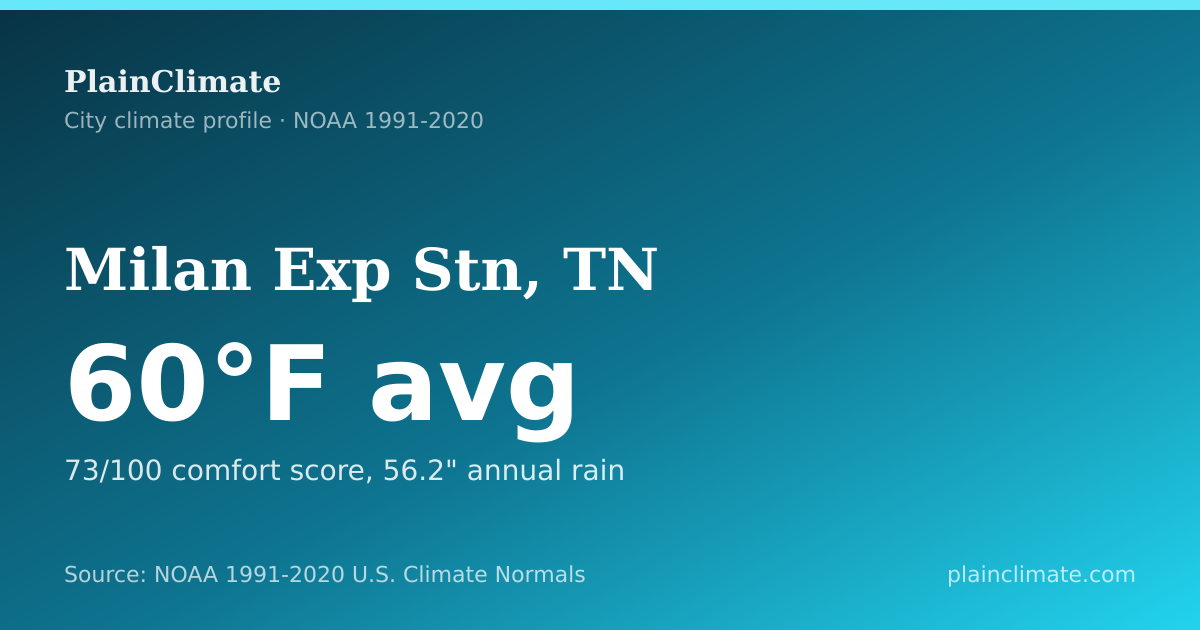
Water is the standout signal in Milan Exp Stn, Tennessee: 56.2 inches of precipitation in a normal year. Against that wet profile, NOAA records an annual average of 60°F. Its climate comfort score of 73/100 (good) lands mid-pack nationally, exceeding 66% of station-mapped location scores.
- 60°F
- average temperature, NOAA 1991-2020 normal
- 73/100
- comfort score, above 66% of station-mapped location scores
- 56.2"
- annual precipitation · 3" snow
- 207 days
- frost-free growing season
Milan Exp Stn: NOAA 1991-2020 normals describe a typical year, not a forecast. Method: /methodology.
Normals record plate
Sheet USC00406012 · Milan Exp Stn, TN 60°F mean · 56.2" precip
TEMP-MILD · RANK-UPPER · PHOTO-FINISH · PRCP-WET · SWING-MID · COMF-MID · LOAD-HEAT · STN-1 · BOOK-FULL
- TEMP-MILD 60°F
- RANK-UPPER #5,077
- PHOTO-FINISH ≈ Paragould
- PRCP-WET 56.2"
- SWING-MID 42°F
- COMF-MID 73/100
- LOAD-HEAT 3,676 HDD
- STN-1 USC00406012
- BOOK-FULL 6/6 fields
Nearest mean-temperature peer: Paragould, AR (+ 0 °F mean)
Instrument codes from this station's NOAA 1991–2020 normals, mean temperature, corpus warmth rank, photo-finish peer station, precipitation band, seasonal swing, comfort composite, degree-day load, and field book, not a livability rating.
Mean-temperature neighbourhood
Nationwide NOAA normal poles and nearest peers, not a reprint of every TN station list.
- Milan (this station) 60°F
- Cold Batesville L&d, AR 60°F
- Hot Spavinaw, OK 60°F
- Near Paragould, AR 60°F
- Near Conchas Dam, NM 60°F
Climate Living Index · Milan Exp Stn
Milan Exp Stn: 63/100 · grade C
Milan Exp Stn publishes 5 of 6 Living Index dimensions (NOAA annual/seasonal normals · NOAA daily multivariate normals); 1 missing weight rescale to 100.
PlainClimate-derived for Milan Exp Stn, not an official NOAA rating. Rankings still use Comfort Score 73/100 (separate formula). Breakpoints and limits.
| Dimension | Station value | Score |
|---|---|---|
| Annual temperature balance | 59.7°F · 7.8° from 67.5°F | 75/100 · B |
| Snowfall burden | 3.0 inches/year | 74/100 · B |
| Frost-free season | 207 days/year | 69/100 · C |
| Normal heat + freeze calendar | 117 calendar days | 66/100 · C |
| Precipitation balance | 56.2 in · 21.2 from 35 in | 24/100 · F |
Milan Exp Stn · 2026-08-04 · NOAA NCEI Climate Normals · method · Comfort Score method.
Milan Exp Stn is a temperate Köppen climate: Cfa
Coldest-month mean 37.9°F and warmest-month mean 79.9°F place this station in temperate, no dry season, hot summer climates (Cfa). Class Cfa is the Peel et al. (2007) label for this station's monthly mean temperature and precipitation normals: temperate, specifically temperate, no dry season, hot summer.
- Köppen code
- Cfa
- Group
- Temperate
- Warmest month
- 79.9°F
- Coldest month
- 37.9°F
Source: official public datasets monthly normals (1991–2020) at the city’s primary station. This is a station classification, not a mapped regional consensus.
National standing · heating-led station
Where Milan Exp Stn sits across the climate record
Three NOAA fields for Milan Exp Stn's primary station, temperature, precipitation, and seasonal swing, are ranked against every station-mapped normal that carries the same field.
- Annual temperature
- Top 26% warmest
- Among 6,861 stations, Milan Exp Stn sits in the warmer third of annual means.
- Annual precipitation
- Top 10% wettest
- Milan Exp Stn's annual total ranks in the wetter third of 6,352 measured normals.
- Seasonal temperature swing
- 45th percentile swing
- Typical seasonal amplitude versus 6,861 complete station-years.
How Milan Exp Stn compares across U.S. station-mapped locations
Milan Exp Stn's comfort score vs. all station-mapped locations
PlainClimate composite comfort index (1–100), NOAA 1991–2020 normals
73 Top 34% score exceeds 66% of 6,189 station-mapped location scores
- 0–10: 0 station-mapped locations (0%). Below this entry.
- 10–20: 0 station-mapped locations (0%). Below this entry.
- 20–30: 96 station-mapped locations (2%). Below this entry.
- 30–40: 280 station-mapped locations (5%). Below this entry.
- 40–50: 1,113 station-mapped locations (18%). Below this entry.
- 50–60: 1,329 station-mapped locations (21%). Below this entry.
- 60–70: 1,236 station-mapped locations (20%). Below this entry.
- 70–80: 650 station-mapped locations (11%). This entry sits in this band.
- 80–90: 921 station-mapped locations (15%). Above this entry.
- 90–100: 564 station-mapped locations (9%). Above this entry.
Source NOAA U.S. Climate Normals, PlainClimate comfort index · 1991–2020
Milan Exp Stn's measured station temperature trend
MethodologyAcross 52 complete annual observations from 1949 to 2025, MILAN EXP STN warmed at a fitted rate of 0.11°C per decade. The line shows the fitted change relative to its first year, not raw year-to-year temperatures or a forecast.
- Milan Exp Stn primary station fitted change +0.11 °C/decade
Monthly Temperatures
Average daily high and low temperatures by month
| Month | Avg High | Avg Low | Mean | Precip | Snow | Freeze Days | 90°F+ Days |
|---|---|---|---|---|---|---|---|
| January | 48°F (9°C) | 28°F (-2°C) | 38°F (3°C) | 4.2" | 1.5" | 21.9 | 0.0 |
| February | 53°F (11°C) | 31°F (0°C) | 42°F (5°C) | 4.7" | 0.9" | 17.5 | 0.0 |
| March | 62°F (17°C) | 39°F (4°C) | 50°F (10°C) | 5.3" | 0.3" | 11.1 | 0.0 |
| April | 72°F (22°C) | 47°F (9°C) | 60°F (15°C) | 5.3" | 0.0" | 2.8 | 0.1 |
| May | 80°F (27°C) | 58°F (14°C) | 69°F (21°C) | 6.2" | 0.0" | 0.1 | 2.3 |
| June | 87°F (31°C) | 66°F (19°C) | 77°F (25°C) | 4.4" | 0.0" | 0.0 | 12.1 |
| July | 90°F (32°C) | 70°F (21°C) | 80°F (27°C) | 4.3" | 0.0" | 0.0 | 19.0 |
| August | 90°F (32°C) | 67°F (19°C) | 78°F (26°C) | 3.7" | 0.0" | 0.0 | 17.1 |
| September | 84°F (29°C) | 59°F (15°C) | 72°F (22°C) | 4.2" | 0.0" | 0.0 | 7.8 |
| October | 74°F (23°C) | 47°F (8°C) | 60°F (16°C) | 3.7" | 0.0" | 3.5 | 0.8 |
| November | 61°F (16°C) | 37°F (3°C) | 49°F (10°C) | 4.8" | 0.1" | 13.2 | 0.0 |
| December | 51°F (11°C) | 31°F (-1°C) | 41°F (5°C) | 5.4" | 0.2" | 19.8 | 0.0 |
The year, day by day
Milan Exp Stn works both ends of the calendar. Normal highs climb to 91°F by July 31 and hold at or above 90°F on 45 dates, then normal lows drop to freezing or below on 72 dates, bottoming at 27°F around January 16.
When the heat sits
Normal highs reach 90°F from July 7 through August 20, covering 45 dates. The broader mild season, normal highs of 70°F or more, runs April 9 to October 25.
This counts calendar dates whose 1991–2020 normal high reaches 90°F. It is a smaller number than the 90°F+ day counts in the monthly table above, which measure how often the threshold was actually crossed in a typical year. A date can average 88°F and still exceed 90°F in half of all years.
The freezing stretch
The normal low stays at or below 32°F into February 18, then returns to freezing around December 9, covering 72 dates in all.
Derived from the normal daily minimum. This is a different measure from the 50%-probability frost dates shown elsewhere on this page, which come from NOAA’s frost product.
Where the wet dates fall
The likeliest wet date is December 23, when 38% of years recorded at least a hundredth of an inch. The driest is September 17 at 23%. Summed across the calendar, that is about 120 wet dates a year.
The widest day
October 19 carries the biggest normal gap between afternoon and dawn, 27°F between the normal high and the normal low.
Look up any date
Any date's 1991–2020 normal for Milan Exp Stn.
Where Milan Exp Stn Stands Nationally
This is one of the wettest normals climates ranked: about 56 inches of precipitation in a normal year, a total fewer than one station in ten surpasses.
Milan Exp Stn earns one nationally notable standing (outer quintile) against 6,860 NOAA 1991–2020 normals stations, middle-of-the-pack metrics stay silent here.
Monthly Precipitation
Average monthly rainfall and snowfall
Snow: 1.5"
11.0 days with precipitation
Snow: 0.9"
10.5 days with precipitation
Snow: 0.3"
11.9 days with precipitation
11.1 days with precipitation
11.7 days with precipitation
9.6 days with precipitation
9.6 days with precipitation
7.9 days with precipitation
6.8 days with precipitation
8.1 days with precipitation
Snow: 0.1"
10.2 days with precipitation
Snow: 0.2"
11.6 days with precipitation
Milan Exp Stn spreads its precipitation across the year
Neither half of the year dominates here: June through August take 22% of the annual total and December through February 25%, with neither reaching the 35% that would mark a distinct wet season. Milan Exp Stn has no dry season to plan around, though it does carry a 42°F seasonal spread.
The gap between the wettest and driest month still matters: May averages 6.2" and October 3.7". The three wettest months together take 30% of the year, against the 25% a perfectly flat distribution would give them.
Shares are computed from this station's own 1991-2020 monthly precipitation normals. "Spread across the year" means neither the June-August nor the December-February share reaches 35%; it describes an average year, not the variability of any single one.
When it rains in Milan Exp Stn, it arrives in quantity
56.2" of precipitation falls across only about 120 wet days here, averaging 0.47 inches each. Fewer days carry more water: the year's total is delivered in comparatively heavy events rather than persistent damp.
- Days with measurable precipitation
- about 120 a year, 33% of all days
- Average depth per wet day
- 0.47 inches
- Most wet days
- March, about 12
- Fewest wet days
- September, about 7
A wet day is one recording at least 0.01 inches. These are 1991-2020 normals: they describe an average year, and a per-day average is not a forecast of any individual storm.
Snow reaches Milan Exp Stn, but rarely amounts to much
The normals record 3.0 inches of snow a year here, most likely in January. That is a real but marginal amount: enough that snow is part of the local record, not enough to define the winter.
A figure in this range usually reflects a handful of events that melt quickly rather than a season of accumulation; about 3 days a year record any measurable snow at all.
NOAA 1991-2020 normals. An average across thirty years can smooth away a single heavy winter, so a small annual figure does not mean a significant snowfall is impossible.
Frost Dates & Growing Season
First Fall Freeze
October 28
50% probability date
Last Spring Freeze
April 4
50% probability date
Growing Season
207 days
Heating & Cooling Degree Days
Annual totals indicate energy demand for heating and cooling
Heating Degree Days
3,676
Higher = more heating needed
Cooling Degree Days
1,766
Higher = more cooling needed
Warmest Month
July
Coldest Month
January
Nationwide similar cities
Other rankable U.S. places outside TN closest to Milan Exp Stn on two NOAA annual-normal axes (mean temperature and annual precipitation). Chip rows use distinct link sets.
Closest by average temperature
Nearest out-of-state peers by annual mean temperature (60°F here).
- Cary, NC 60°F · 0.0°F off
- Centre, AL 60°F · 0.0°F off
- Chapel Hill, NC 60°F · 0.0°F off
- Emporia, VA 60°F · 0.0°F off
Closest by annual precipitation
Nearest out-of-state peers by annual precipitation (56.2" here), excluding temperature-peer places.
- Mableton, GA 56.2" · 0.0" off
- Sparkman, AR 56.2" · 0.0" off
- Valley Head, AL 56.2" · 0.0" off
- Plant City, FL 56.1" · 0.1" off
Data-derived climate profile
How Milan Exp Stn's climate pattern fits together
heating led · wet · mid swing
Milan Exp Stn's energy balance leans toward cold weather: 3,676 annual heating degree days against 1,766 for cooling. Its 42.0°F seasonal range still makes the monthly rows more useful than the annual average alone.
Milan Exp Stn's frost-free season lasts about 207 days, a middle-length window whose endpoints matter more than the annual average. It describes freeze probability, not year-specific planting conditions.
July and January mark the typical warm and cold ends of the calendar in Milan Exp Stn's middle-range seasonal profile. The measured spread is 42.0°F. The annual average is 60°F. Neither the annual mean nor one extreme month represents the full calendar on its own.
Alongside its heating load, Milan Exp Stn carries 56.2 inches of precipitation in a normal year, inside PlainClimate's wet range. Annual snowfall totals 3.0 inches. That distinction matters because a wet annual total can arrive as rain, snow, or a mixture at different times.
These labels group NOAA 1991-2020 normals from Milan Exp Stn's primary station, so the winter figures are a thirty-year average and not a floor: a single hard season can run well below them. Treat each band as a descriptive range for Milan Exp Stn, not an official NOAA class or a year-ahead forecast.
Questions about Milan Exp Stn's climate
How much rain does Milan Exp Stn get? ▼
How many days above 90°F does Milan Exp Stn get? ▼
How much energy does heating and cooling require in Milan Exp Stn? ▼
Data Sources
Data source: NOAA U.S. Climate Normals v1.0.1 (1991-2020). All figures on this page are from Milan Exp Stn's primary station: MILAN EXP STN (USC00406012). For informational purposes only.
Place identity: U.S. Census Bureau 2024 Gazetteer places. The conservative exact name-and-state crosswalk finds no Census place match, so PlainClimate treats this as a station-mapped location and does not claim it is a municipality. No exact Gazetteer row for Milan Exp Stn; facility counts that depend on place identity are therefore an upper bound, not a municipal census.
On this page every temperature, precipitation, and derived score for Milan Exp Stn comes from its primary NOAA station record. No figure on this page is typed in by an editor - each value is rendered from NOAA 1991-2020 U.S. Climate Normals. See our editorial standards & corrections policy, the methodology behind these numbers, or report a data error. Data current as of 1991–2020 normals.