Climate Comfort Score
N/A
NOAA 1991-2020 normals
Annual temperature, rainfall, and a comfort score, sourced from NOAA NCEI's 1991–2020 normals →
30-year climate normals (1991-2020) from Fort Lauderdale Hollywood's primary NOAA station, FT LAUDERDALE HOLLYWOOD AP.
The climate verdict for Fort Lauderdale Hollywood
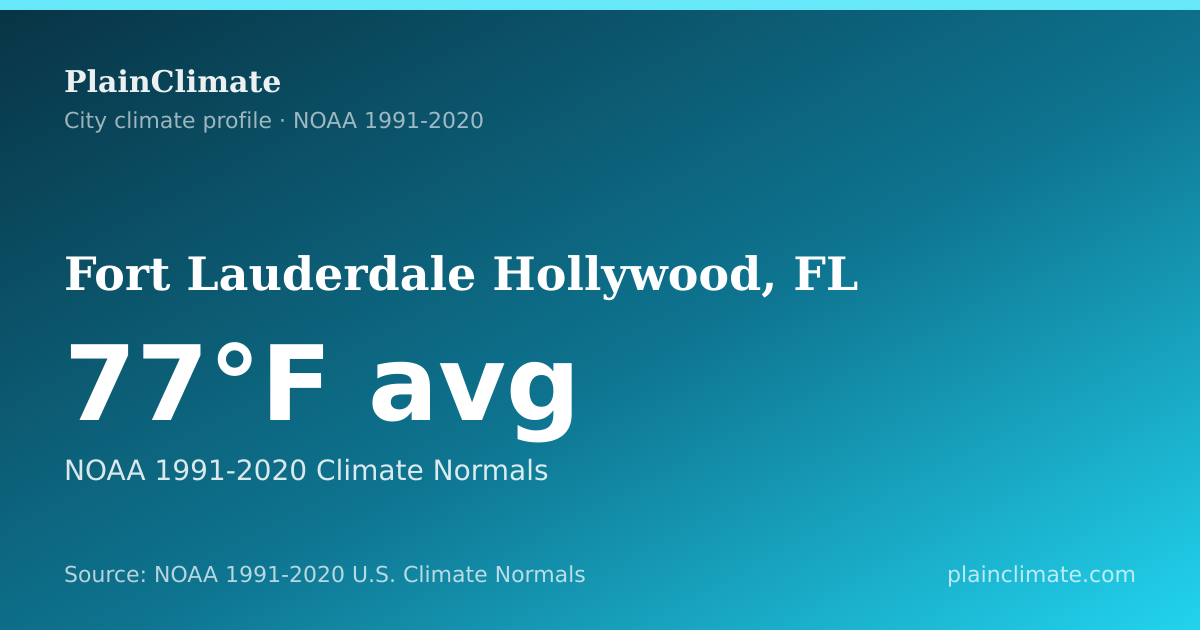
Warm-season cooling demand defines Fort Lauderdale Hollywood, Florida, running at more than twice its heating total. The NOAA normal records an annual average of 77°F. August is the warmest month at 84°F and January the coldest at 68°F.
Based on NOAA U.S. Climate Normals (1991–2020) - 30-year averages describing the typical year, not a forecast.
Avg Temperature
77°F (25°C)
Avg High
84°F
Avg Low
71°F
Annual Precip
61.0"
Fort Lauderdale Hollywood sits in Florida, the #1 hottest U.S. state at 72.6°F statewide annual average - see all 50 hottest states ranked by NOAA normals
Climate Comfort Score
N/A
NOAA 1991-2020 normals
Avg Annual Temperature
77°F
30-year mean (NOAA NCEI)
Annual Precipitation
61.0"
Liquid-equivalent total
Against the 6 closest stations in the record, Fort Lauderdale Hollywood averages 77°F a year, warmer than Hollywood, FL (76°F) and Fort Lauderdale, FL (76°F).
Corpus-relative placement
These comparisons place this primary-station normal among station-mapped locations with the same NOAA 1991–2020 fields.
Average daily high and low temperatures by month
| Month | Avg High | Avg Low | Mean | Precip | Freeze Days | 90°F+ Days |
|---|---|---|---|---|---|---|
| January | 76°F (24°C) | 61°F (16°C) | 68°F (20°C) | 2.9" | 0.0 | 0.0 |
| February | 77°F (25°C) | 63°F (17°C) | 70°F (21°C) | 2.4" | 0.0 | 0.0 |
| March | 80°F (27°C) | 66°F (19°C) | 73°F (23°C) | 2.4" | 0.0 | 0.8 |
| April | 83°F (28°C) | 70°F (21°C) | 76°F (25°C) | 3.0" | 0.0 | 1.6 |
| May | 86°F (30°C) | 74°F (23°C) | 80°F (27°C) | 5.6" | 0.0 | 2.9 |
| June | 88°F (31°C) | 77°F (25°C) | 83°F (28°C) | 9.6" | 0.0 | 11.5 |
| July | 90°F (32°C) | 78°F (25°C) | 84°F (29°C) | 5.4" | 0.0 | 18.3 |
| August | 90°F (32°C) | 78°F (26°C) | 84°F (29°C) | 7.9" | 0.0 | 20.1 |
| September | 88°F (31°C) | 77°F (25°C) | 83°F (28°C) | 8.0" | 0.0 | 10.7 |
| October | 85°F (30°C) | 74°F (24°C) | 80°F (27°C) | 7.4" | 0.0 | 2.0 |
| November | 81°F (27°C) | 68°F (20°C) | 75°F (24°C) | 3.7" | 0.0 | 0.0 |
| December | 78°F (25°C) | 65°F (18°C) | 71°F (22°C) | 2.8" | 0.0 | 0.0 |
The year in Fort Lauderdale Hollywood runs from a mild 60°F around January 15 to 91°F at the peak near July 28, and the normal low never reaches freezing on any date in the record.
Normal highs reach 90°F from July 14 through August 18, covering 36 dates. The broader mild season, normal highs of 70°F or more, runs January 1 to December 31.
This counts calendar dates whose 1991–2020 normal high reaches 90°F. It is a smaller number than the 90°F+ day counts in the monthly table above, which measure how often the threshold was actually crossed in a typical year. A date can average 88°F and still exceed 90°F in half of all years.
Not one calendar date in the 1991–2020 record carries a normal low at or below 32°F. The coldest normal low of the year is 60°F around January 15.
The likeliest wet date is August 28, when 56% of years recorded at least a hundredth of an inch. The driest is February 13 at 19%. Summed across the calendar, that is about 131 wet dates a year.
January 18 carries the biggest normal gap between afternoon and dawn, 15°F between the normal high and the normal low.
Any date's 1991–2020 normal for Fort Lauderdale Hollywood.
This is one of the wettest normals climates ranked: about 61 inches of precipitation in a normal year, a total fewer than one station in ten surpasses.
Among the steadiest day-night climates ranked: even the widest normal daily swing holds to roughly 15°F.
Standing computed against the distribution of 6,860 NOAA 1991–2020 normals stations in the PlainClimate database; only nationally notable standings are shown.
Average monthly rainfall
7.0 days with precipitation
5.9 days with precipitation
6.3 days with precipitation
6.6 days with precipitation
10.4 days with precipitation
16.0 days with precipitation
15.7 days with precipitation
17.0 days with precipitation
16.1 days with precipitation
12.2 days with precipitation
9.6 days with precipitation
8.4 days with precipitation
37% of Fort Lauderdale Hollywood's yearly precipitation falls in June, July and August alone, against the 25% an evenly spread year would give those three months. The wettest month is June at 9.6", on an unusually narrow 15.7°F seasonal spread. Warm-season convection and, across the Southwest, the North American monsoon produce this shape: rain arrives in short heavy bursts during the hottest part of the year rather than as long cool-season soaking.
Shares are computed from this station's own 1991-2020 monthly precipitation normals. A summer-peaked label means the June-August share reaches 35%; it describes timing across an average year, not any single season, and says nothing about how heavy an individual storm can be.
60.9" of precipitation falls across only about 131 wet days here, averaging 0.46 inches each. Fewer days carry more water: the year's total is delivered in comparatively heavy events rather than persistent damp.
A wet day is one recording at least 0.01 inches. These are 1991-2020 normals: they describe an average year, and a per-day average is not a forecast of any individual storm.
First Fall Freeze
N/A
50% probability date
Last Spring Freeze
N/A
50% probability date
Annual totals indicate energy demand for heating and cooling
Heating Degree Days
122
Higher = more heating needed
Cooling Degree Days
4,573
Higher = more cooling needed
Warmest Month
August
Coldest Month
January
NOAA 1991–2020 annual normals connect this location to non-geographic peers. Temperature peers use annual mean temperature; energy peers use both heating and cooling degree days.
What Fort Lauderdale Hollywood's climate means for you
Fort Lauderdale Hollywood runs 77°F a year - peaking in August, coldest in January.
Data-derived climate profile
cooling led · wet · low swing
Warm-season load persists through a relatively even calendar in Fort Lauderdale Hollywood. Cooling totals 4,573 degree days, more than double the 122 heating measure, and the 15.7°F seasonal range is compact rather than sharply divided.
Warm-season demand is paired with a wet annual normal: 61.0 inches of precipitation at Fort Lauderdale Hollywood. Snowfall is not added to the interpretation because its annual value is missing. The month-by-month bars distinguish a concentrated wet season from moisture spread across the calendar.
Fort Lauderdale Hollywood's 15.7°F seasonal spread is compact even though precipitation is abundant. August and January mark the typical warm and cold ends of the calendar. The annual average is 77°F. Temperature is relatively steady; the monthly rows show how rain and snow observations vary across the calendar.
A frost-free growing-season length is not available for Fort Lauderdale Hollywood. That missing field is kept separate from the observed temperature and precipitation record rather than filled from a regional estimate.
These labels group NOAA 1991-2020 normals from Fort Lauderdale Hollywood's primary station, so the summer figures are a thirty-year average rather than a ceiling: individual years have run hotter and will again. They are descriptive ranges, not an official NOAA classification or a forecast for any specific year.
Data source: NOAA U.S. Climate Normals v1.0.1 (1991-2020). All figures on this page are from Fort Lauderdale Hollywood's primary station: FT LAUDERDALE HOLLYWOOD AP (USW00012849). For informational purposes only.
Place identity: U.S. Census Bureau 2024 Gazetteer places. The conservative exact name-and-state crosswalk finds no Census place match, so PlainClimate treats this as a station-mapped location and does not claim it is a municipality. The reproducible method is an exact normalized name-and-state match; unresolved is an upper bound on facilities because spelling variants can be missed.
Every figure on PlainClimate is rendered directly from NOAA 1991-2020 U.S. Climate Normals data, no number is typed in by an editor. See our editorial standards & corrections policy, the methodology behind these numbers, or report a data error.